



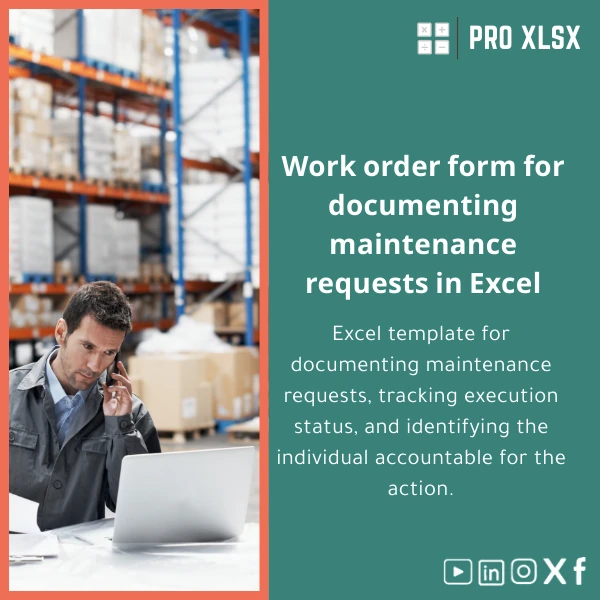
Work Order Tracker Excel Template for Maintenance Management
Original price was: $37.53.$26.73Current price is: $26.73.
A practical Work Order Tracker in Excel to register maintenance requests, monitor status, assign responsible staff, and produce operational reports — designed for accountants, data analysts, and companies that need fast, reliable maintenance work order logging without heavy systems.
Key benefits & value for buyers
The Work Order Tracker is a practical work order template Excel built to reduce manual work and increase visibility across maintenance operations. Below are the core benefits translated into measurable value:
- Reduce response time: structured request capture and SLA flags help teams prioritize urgent jobs and reduce downtime.
- Improve accountability: every request stores requester, assignee, and timestamp so auditors and managers can trace decisions.
- Faster reporting: prebuilt pivot-ready tables and dashboard charts cut the time to prepare weekly and monthly maintenance reports.
- Lower cost than CMMS: immediate value without expensive software or long implementation—ideal for SMEs and finance teams tracking maintenance costs.
- Flexible data model: exportable to CSV or power BI-ready tables for advanced analysis by accountants and data analysts.
Use cases & real-life scenarios
Daily operations
A facilities supervisor logs incoming requests (plumbing, electrical, cleaning), assigns technicians, and updates status. The dashboard highlights overdue jobs and technician utilization so workload can be rebalanced.
Monthly cost reporting
Accountants export the maintenance log to produce expense categories per site or department. The template tags parts, labor hours, and external contractor fees for clean financial consolidation.
Audit & compliance
Auditors use the timestamped history and sign-off fields to verify that preventive maintenance was executed as scheduled, providing evidence during reviews.
Who is this product for?
The Work Order Tracker suits organizations and professionals who need a practical, Excel-based maintenance work order log:
- Accountants and controllers consolidating maintenance spend and assets.
- Data analysts preparing asset utilization and downtime analysis.
- Small-to-medium enterprises that cannot justify a full CMMS.
- Maintenance supervisors who need printable work orders and simple automation.
- Consultants and auditors preparing maintenance reports for clients.
How to choose the right version
The template is offered in versions depending on the level of automation and team size:
- Standard (Excel only): formulas, filters, dashboard — best for single users or small teams.
- Advanced (with VBA): includes macros for bulk status updates, printable forms, and export routines — choose this if you want automated tasks.
- Customized (hourly service): request ProXlsx hourly customization if you need localization, additional fields, or integration with accounting charts.
If you’re unsure, choose Standard and request a short customization session — our hourly service converts the template to match your workflow in under a day for typical requests.
Quick comparison with typical alternatives
Compared to manual paper logs: this template centralizes data, searchable and auditable. Compared to full CMMS: it is far less expensive and faster to implement, though CMMS may be better for very large, regulated operations with IoT integrations. Compared to generic spreadsheets: this template is structured for maintenance metrics (SLA, priority, parts, labor) and includes reporting-ready sheets.
Best practices & tips to get maximum value
- Standardize request fields (location, asset code, priority) before you start logging to keep data clean.
- Train technicians on status codes (Open, In Progress, On Hold, Closed) and require short closure notes for audit trails.
- Use the dashboard weekly: filter by site and technician to spot bottlenecks early.
- If you use the VBA version, enable macros from a trusted location and backup the file before running bulk operations.
- Export monthly snapshots for accounting — keep a read-only archive sheet for historical audits.
Common mistakes when buying/using maintenance templates — and how to avoid them
- Buying generic spreadsheets: they lack maintenance-specific fields. Choose a work order template Excel designed for operational data.
- Skipping training: poor adoption leads to inconsistent data. Allocate 30 minutes to train users.
- Ignoring backups: always version the file weekly to prevent data loss.
- Not defining responsibilities: without assigned owners, requests stall. Use the assignee and SLA fields strictly.
Product specifications
- File format: .xlsx (Standard), .xlsm (VBA/Advanced)
- Compatible with: Excel 2016, 2019, Microsoft 365 (Windows recommended for full VBA support)
- Sheets included: Request Log, Dashboard, Technicians, Parts & Costs, Printable Work Order, Audit Trail
- Core features: status tracking, priority, SLA highlights, pivot-ready tables, prebuilt charts
- Customization: available by the hour — local language, fields, and integrations
- Delivery: instant digital download after purchase; customization by agreement
- Usage notes: enable macros only for .xlsm file; recommended daily backups
Frequently asked questions
Which Excel versions are supported and do macros work on Mac?
Can I customize fields, language, or add cost codes?
Is my data secure after purchase?
What support is included after purchase?
Ready to stop losing time on maintenance requests?
Deploy a structured work order tracking system today and start producing actionable reports from day one. Perfect for accountants, data analysts, and operations teams that need a fast, professional solution.
Prefer customization? Contact ProXlsx for a short implementation session — convert the template to your workflow in hours, not weeks.






Reviews
Clear filtersThere are no reviews yet.